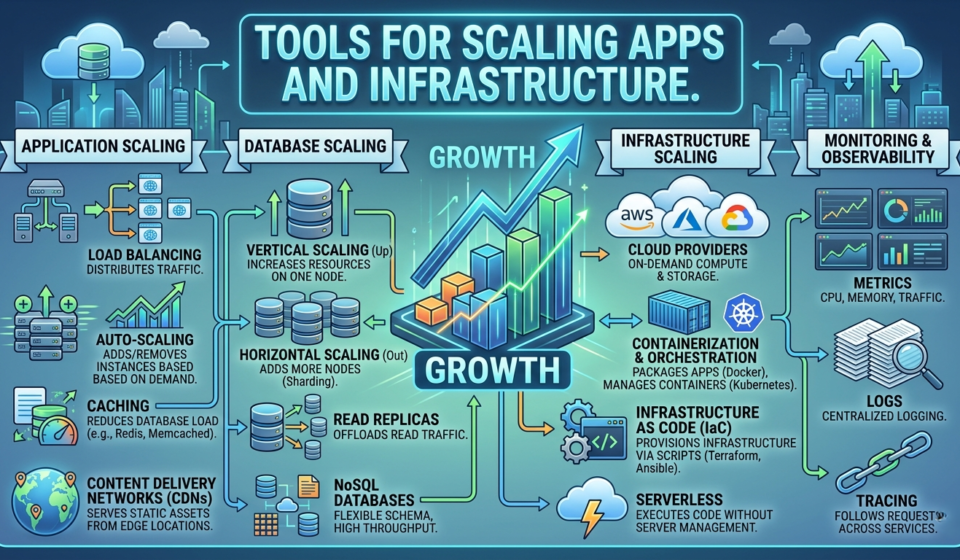

In today’s digital economy, applications are expected to handle millions of users, process enormous amounts of data, and deliver seamless performance around the clock. Whether you are running a startup, SaaS platform, eCommerce business, or enterprise system, scalability is no longer optional—it is essential. Modern businesses must adopt the right tools and infrastructure strategies to ensure applications remain fast, reliable, and secure as demand grows.
Scaling applications and infrastructure involves expanding computing resources, optimizing system performance, automating deployments, and improving monitoring capabilities. Fortunately, a wide range of modern tools can help businesses achieve these goals efficiently.
This article explores the most important tools for scaling apps and infrastructure, including cloud platforms, containerization technologies, orchestration systems, monitoring tools, databases, and DevOps solutions.
Why Scalability Matters
Scalability refers to a system’s ability to handle increased workloads without compromising performance. As businesses grow, application traffic, user requests, and data processing needs also increase.
Without scalable infrastructure, organizations may face:
- Slow application performance
- System crashes during high traffic
- Increased downtime
- Poor user experience
- Revenue loss
- Security vulnerabilities
Modern scalable systems are designed to adapt dynamically to growing demand while maintaining reliability and efficiency. Cloud computing, automation, and distributed architectures have made this easier than ever before.
1. Cloud Platforms for Scalable Infrastructure
Cloud computing platforms provide on-demand infrastructure resources such as servers, storage, networking, and databases. They eliminate the need for expensive physical hardware while offering flexibility and scalability.
Amazon Web Services (AWS)
AWS is one of the most widely used cloud platforms globally. It provides hundreds of services for scalable application deployment.
Popular AWS scaling tools include:
- EC2 Auto Scaling
- Elastic Load Balancer
- Amazon RDS
- Lambda Serverless Functions
- Elastic Kubernetes Service (EKS)
AWS enables businesses to automatically scale resources based on traffic demands. Startups and enterprises alike use AWS for highly available applications.
Microsoft Azure
Microsoft Azure offers enterprise-grade cloud infrastructure with strong integration for Windows-based environments.
Key Azure scaling services include:
- Virtual Machine Scale Sets
- Azure Kubernetes Service (AKS)
- Azure Functions
- Azure SQL Database
- Azure Monitor
Azure is particularly popular among enterprises already using Microsoft technologies.
Google Cloud Platform (GCP)
Google Cloud Platform is known for high-performance computing and data analytics.
Important scaling tools include:
- Google Kubernetes Engine (GKE)
- Cloud Run
- BigQuery
- Compute Engine
- Cloud Load Balancing
GCP is widely used for AI, machine learning, and high-scale data processing applications.
2. Containerization Tools
Containerization allows developers to package applications with all dependencies into isolated environments. Containers improve consistency, portability, and scalability.
Docker
Docker is the most popular containerization platform.
Benefits of Docker include:
- Lightweight deployment
- Faster application startup
- Simplified dependency management
- Consistent environments across development and production
- Easier scaling
Docker containers help businesses deploy microservices efficiently across multiple servers.
Podman
Podman is a daemonless container engine that offers improved security and flexibility compared to Docker in some environments.
Advantages include:
- Rootless containers
- Better Linux integration
- Kubernetes compatibility
- Enhanced security controls
Many organizations are adopting Podman for enterprise container management.
3. Kubernetes and Container Orchestration
Managing hundreds or thousands of containers manually becomes impossible at scale. This is where orchestration platforms become critical.
Kubernetes
Kubernetes is the industry standard for container orchestration.
It automates:
- Container deployment
- Scaling
- Load balancing
- Networking
- Self-healing
- Resource management
Kubernetes enables organizations to run highly scalable distributed applications across clusters of servers. Major companies use Kubernetes for mission-critical workloads.
Key Kubernetes platforms include:
- Amazon EKS
- Azure AKS
- Google GKE
- Red Hat OpenShift
Docker Swarm
Docker Swarm is a simpler orchestration solution compared to Kubernetes.
Features include:
- Easy setup
- Integrated Docker support
- Load balancing
- Scaling services
It is suitable for smaller projects and teams seeking lightweight orchestration.
4. Load Balancing Tools
Load balancing distributes incoming traffic across multiple servers to prevent overload and ensure availability.
NGINX
NGINX is one of the most popular web servers and reverse proxies.
It supports:
- Traffic distribution
- Caching
- SSL termination
- API gateway functionality
- High-performance web serving
NGINX is widely used in scalable web architectures.
HAProxy
HAProxy is a high-performance TCP and HTTP load balancer.
Benefits include:
- High reliability
- Advanced traffic routing
- Health checks
- Session persistence
- Scalability optimization
Large-scale applications frequently use HAProxy for backend traffic management.
5. Monitoring and Observability Tools
As infrastructure grows, monitoring becomes essential for identifying issues before they impact users.
Prometheus
Prometheus is an open-source monitoring platform designed for cloud-native applications.
Key features:
- Time-series database
- Real-time metrics
- Alerting
- Kubernetes integration
- Powerful querying
Prometheus is commonly paired with Grafana for visualization dashboards.
Grafana
Grafana helps visualize application and infrastructure metrics.
It supports:
- Interactive dashboards
- Real-time monitoring
- Multi-source integration
- Performance tracking
- Alert notifications
Grafana improves visibility into large-scale systems.
Datadog
Datadog is a cloud-based monitoring and security platform.
Capabilities include:
- Infrastructure monitoring
- Application performance management (APM)
- Log management
- Security monitoring
- AI-driven alerts
Many enterprises use Datadog for centralized observability.
6. CI/CD and DevOps Tools
Continuous Integration and Continuous Deployment (CI/CD) automate software delivery pipelines.
Jenkins
Jenkins is a widely used automation server.
It helps teams:
- Automate builds
- Run tests
- Deploy applications
- Manage CI/CD workflows
Jenkins supports thousands of plugins and integrations.
GitHub Actions
GitHub Actions enables developers to automate workflows directly within GitHub repositories.
Benefits include:
- Easy automation
- Built-in CI/CD
- Cloud deployment integration
- Fast setup
- Strong developer collaboration
GitHub Actions is increasingly popular for modern DevOps pipelines.
GitLab CI/CD
GitLab offers integrated DevOps capabilities in a single platform.
Features include:
- Source control
- CI/CD automation
- Security scanning
- Infrastructure management
- Monitoring integration
It simplifies software delivery workflows significantly.
7. Database Scaling Tools
Databases are often the bottleneck in high-traffic systems.
PostgreSQL
PostgreSQL is a powerful open-source relational database.
Scaling features include:
- Replication
- Partitioning
- High availability
- Performance optimization
- Advanced indexing
It is ideal for enterprise-grade applications.
MongoDB
MongoDB is a NoSQL database designed for scalability and flexibility.
Advantages include:
- Horizontal scaling
- Sharding
- Flexible schemas
- Fast document storage
- Cloud-native support
MongoDB works well for rapidly growing applications.
Redis
Redis is an in-memory database often used for caching and performance optimization.
Use cases include:
- Session management
- Real-time analytics
- Queue management
- API caching
Redis dramatically reduces database load and improves response times.
8. Infrastructure as Code (IaC) Tools
Infrastructure as Code automates infrastructure provisioning using configuration files.
Terraform
Terraform is one of the most popular IaC tools.
Benefits include:
- Automated infrastructure deployment
- Multi-cloud support
- Version-controlled infrastructure
- Reduced manual errors
- Consistent environments
Terraform simplifies scaling cloud resources efficiently.
Ansible
Ansible is an automation tool used for configuration management and deployments.
Features include:
- Agentless architecture
- Simple YAML syntax
- Automated server configuration
- Application deployment
- Infrastructure orchestration
Ansible reduces operational complexity significantly.
9. Serverless Computing Tools
Serverless platforms automatically manage infrastructure while developers focus on code.
AWS Lambda
AWS Lambda executes code without provisioning servers.
Advantages:
- Automatic scaling
- Pay-per-use pricing
- Fast deployment
- Reduced infrastructure management
It is ideal for APIs, event-driven systems, and microservices.
Google Cloud Functions
Google Cloud Functions provides event-driven serverless execution.
Common use cases include:
- Backend APIs
- Data processing
- Automation workflows
- Real-time event handling
Serverless computing helps businesses scale quickly while minimizing operational overhead.
10. Security and Scaling Together
Scaling infrastructure without security can expose systems to major threats.
Essential security tools include:
- Cloudflare
- AWS Shield
- Vault by HashiCorp
- Snyk
- CrowdStrike
These tools help protect applications from DDoS attacks, vulnerabilities, and unauthorized access while maintaining scalability.
Best Practices for Scaling Applications
Choosing the right tools is important, but proper implementation matters even more.
Key best practices include:
- Use microservices architecture
- Implement caching strategies
- Optimize databases
- Automate deployments
- Monitor infrastructure continuously
- Use load balancing
- Design stateless applications
- Adopt CI/CD pipelines
- Perform regular stress testing
- Prioritize security from the start
Businesses that combine these practices with modern scaling tools achieve better performance, reliability, and growth potential.
Conclusion
Scaling applications and infrastructure is a critical requirement for modern digital businesses. As user demands continue to increase, organizations must adopt reliable cloud platforms, containerization technologies, orchestration tools, monitoring systems, and automation solutions to stay competitive.
From Kubernetes and Docker to Terraform, Prometheus, and AWS, today’s ecosystem offers powerful tools that simplify scalability while improving reliability and performance. Businesses that invest in scalable architecture can handle growth more efficiently, deliver better user experiences, and reduce operational risks.
In the future, technologies such as AI-driven infrastructure management, edge computing, and serverless architectures will continue transforming the way applications scale. Organizations that embrace these innovations early will gain a significant advantage in the rapidly evolving digital landscape