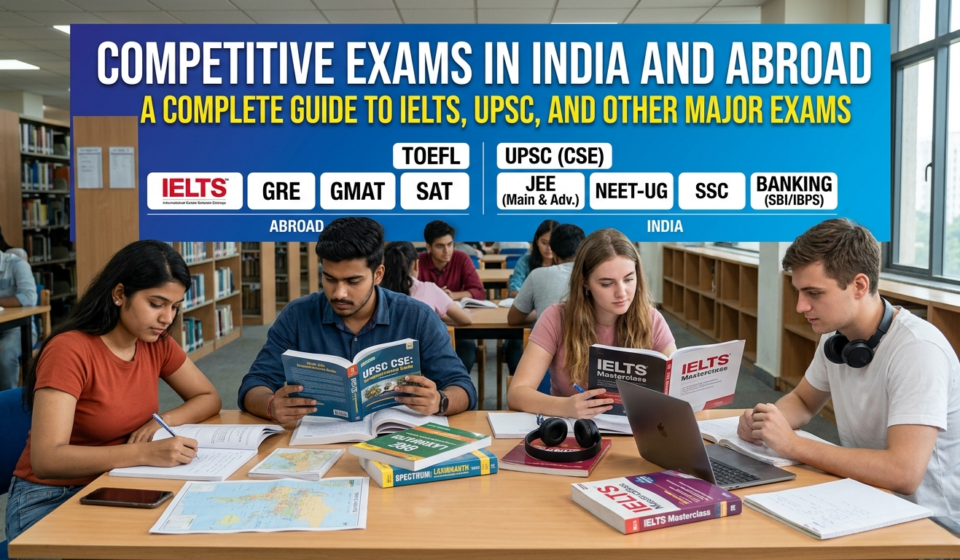

Competitive exams have become an essential gateway for academic admissions, government jobs, and international opportunities. Whether a student dreams of becoming a civil servant through the Union Public Service Commission Civil Services Examination, pursuing higher education abroad with the International English Language Testing System (IELTS), or securing admission into prestigious institutions through exams like JEE, NEET, CAT, or SSC, competitive tests shape millions of careers every year.
In today’s highly competitive world, preparation for these exams requires dedication, strategy, and consistency. Students often spend months or even years preparing for a single examination because the level of competition continues to increase annually. Educational blogs and exam preparation platforms increasingly emphasize structured learning, mock testing, and skill-based preparation as the key to success in modern competitive exams.
What Are Competitive Exams?
Competitive exams are standardized tests conducted to evaluate candidates for admissions, scholarships, certifications, or recruitment. These exams rank students based on performance, and only the best-performing candidates secure seats or positions.
Competitive examinations can be broadly classified into several categories:
- Government job examinations
- Entrance examinations for higher education
- Language proficiency tests
- Banking and railway examinations
- International admission tests
- Professional certification examinations
The primary purpose of these exams is to select deserving candidates fairly and transparently.
Importance of Competitive Exams
Competitive exams play a significant role in shaping careers and educational opportunities. They provide equal opportunities to students from different backgrounds and regions.
1. Merit-Based Selection
Most competitive exams follow a merit-based selection process. This ensures that deserving candidates receive opportunities based on performance rather than personal influence.
2. Career Opportunities
Exams such as UPSC, SSC, Banking, and Railways open doors to stable and respected government careers.
3. International Education
Language proficiency exams like IELTS and TOEFL help students pursue higher education abroad.
4. Skill Development
Preparation for competitive exams improves analytical thinking, time management, communication skills, and problem-solving abilities.
5. Academic Excellence
Students preparing for exams like JEE or NEET develop a deeper understanding of subjects such as Physics, Chemistry, Biology, and Mathematics.
IELTS: International English Language Testing System
The IELTS exam is one of the world’s most recognized English language proficiency tests. It is accepted by universities, employers, and immigration authorities in countries like the UK, Canada, Australia, and New Zealand.
Types of IELTS
There are two major types of IELTS examinations:
- IELTS Academic
- IELTS General Training
The Academic version is designed for students seeking admission to universities, while the General Training version is commonly required for migration and work purposes.
IELTS Exam Structure
The IELTS exam consists of four sections:
- Listening
- Reading
- Writing
- Speaking
The test evaluates a candidate’s ability to communicate effectively in English in academic and professional environments.
Importance of IELTS
IELTS is essential for students planning to study abroad. Many universities require a minimum IELTS band score for admission. Immigration authorities also consider IELTS scores during visa applications.
Tips to Prepare for IELTS
- Practice English daily
- Read newspapers and journals
- Improve vocabulary
- Listen to English podcasts
- Take mock tests regularly
- Practice speaking confidently
Online learning platforms and educational blogs increasingly highlight digital learning tools and mock practice systems as effective methods for IELTS preparation.
UPSC Civil Services Examination
The UPSC Civil Services Examination is considered one of the toughest competitive exams in India. Conducted annually by the Union Public Service Commission, this examination recruits candidates for prestigious services such as:
- IAS (Indian Administrative Service)
- IPS (Indian Police Service)
- IFS (Indian Foreign Service)
Stages of UPSC Examination
The UPSC exam consists of three stages:
1. Preliminary Examination
This stage includes objective-type questions covering General Studies and Aptitude.
2. Main Examination
The mains examination consists of descriptive papers that evaluate analytical and writing skills.
3. Personality Test (Interview)
Candidates who clear the mains examination appear for the interview round.
UPSC Syllabus
The syllabus covers:
- Indian Polity
- History
- Geography
- Economics
- Science and Technology
- Environment
- Current Affairs
- Ethics
Challenges in UPSC Preparation
UPSC preparation demands:
- Long-term dedication
- Consistent revision
- Newspaper reading
- Strong answer-writing practice
- Time management
Many toppers spend one to three years preparing seriously for the examination.
Strategies for UPSC Success
- Understand the syllabus thoroughly
- Follow standard textbooks
- Read newspapers daily
- Practice answer writing
- Revise regularly
- Attempt mock tests
Other Important Competitive Exams in India
JEE (Joint Entrance Examination)
The JEE exam is conducted for admission into engineering colleges, including the prestigious IITs and NITs.
It has two stages:
- JEE Main
- JEE Advanced
Subjects include Physics, Chemistry, and Mathematics.
NEET (National Eligibility cum Entrance Test)
NEET is the primary medical entrance examination in India. Students seeking admission to MBBS, BDS, and other medical courses must qualify for this exam.
Subjects include:
- Physics
- Chemistry
- Biology
CAT (Common Admission Test)
CAT is conducted for admission into top management institutes like the Indian Institutes of Management.
The exam tests:
- Quantitative Aptitude
- Verbal Ability
- Logical Reasoning
- Data Interpretation
SSC Exams
The Staff Selection Commission conducts various examinations for recruitment into government departments.
Popular SSC exams include:
- SSC CGL
- SSC CHSL
- SSC MTS
Banking Exams
Banking examinations are conducted by institutions such as:
- IBPS
- SBI
- RBI
These exams recruit candidates for clerical and officer-level posts.
Railway Exams
The Railway Recruitment Board conducts exams for technical and non-technical railway positions.
Challenges Faced by Students
Preparing for competitive exams is not easy. Students often face multiple challenges.
1. High Competition
Millions of students appear for limited seats or vacancies.
2. Stress and Pressure
Academic pressure and societal expectations often create stress among students.
3. Time Management
Balancing school, coaching, and self-study can be difficult.
4. Lack of Guidance
Many students struggle because of improper planning and lack of mentorship.
5. Financial Constraints
Coaching institutes and study materials can be expensive for some families.
Role of Technology in Exam Preparation
Technology has transformed modern education and competitive exam preparation. Educational platforms now provide:
- Online classes
- Video lectures
- Mock tests
- AI-based performance analysis
- Digital notes
- Interactive quizzes
Modern educational technology and digital learning systems are increasingly becoming central to exam preparation and academic management.
Students can now prepare from home using smartphones and laptops. E-learning platforms have made quality education accessible to students across urban and rural areas.
Importance of Mock Tests
Mock tests are extremely important for competitive exam preparation.
Benefits include:
- Better time management
- Improved accuracy
- Familiarity with exam patterns
- Reduced exam fear
- Performance analysis
Regular mock testing helps students identify strengths and weaknesses effectively.
Time Management Tips for Students
Effective time management is crucial for success in competitive exams.
Create a Study Schedule
A proper timetable helps maintain consistency.
Set Realistic Goals
Daily and weekly targets improve productivity.
Avoid Procrastination
Delaying tasks increases stress and reduces efficiency.
Take Short Breaks
Regular breaks improve concentration and mental freshness.
Focus on Revision
Revision is essential for long-term retention.
Study schedules and strategic preparation methods are frequently recommended by modern educational guidance platforms for improving student performance.
Mental Health During Exam Preparation
Mental health is equally important during competitive exam preparation.
Students should:
- Sleep properly
- Eat healthy food
- Exercise regularly
- Avoid excessive stress
- Stay connected with family and friends
Maintaining a positive mindset improves focus and confidence.
Future of Competitive Exams
The future of competitive examinations is evolving rapidly due to digital transformation.
Emerging trends include:
- Online examinations
- AI-based assessments
- Adaptive testing systems
- Remote proctoring
- Personalized learning
Educational institutions and digital learning platforms continue adopting advanced technologies to improve assessment systems and learning experiences.
Conclusion
Competitive exams such as IELTS, UPSC, JEE, NEET, CAT, SSC, and banking examinations have become crucial milestones in academic and professional careers. These examinations not only test knowledge but also evaluate discipline, determination, analytical thinking, and time management skills.
Success in competitive exams requires proper planning, consistent effort, smart study techniques, and emotional resilience. With the growing influence of technology and digital education, students now have access to advanced learning resources that can significantly improve preparation strategies.
Ultimately, dedication, persistence, and self-belief remain the most important ingredients for success in any competitive examination