
In today’s fast-paced academic environment, students are constantly searching for ways to learn faster, remember more, and stay productive. Yet, many still rely on outdated methods like rereading notes or cramming before exams—techniques that feel productive but deliver poor results.
The truth is simple: effective learning is not about working harder—it’s about working smarter. By combining scientifically proven memory techniques with practical productivity hacks, anyone can dramatically improve their learning efficiency and performance.
This article explores the most powerful strategies to boost memory, enhance focus, and maximize productivity.
Understanding How Memory Works
Before diving into techniques, it’s important to understand how memory functions.
Memory involves three key processes:
- Encoding – Taking in information
- Storage – Keeping information in the brain
- Retrieval – Accessing stored information
Most students struggle not because they “forget,” but because they fail to encode or retrieve information effectively. Passive methods like rereading or highlighting do little to strengthen memory pathways.
To improve memory, you must actively engage your brain.
Part 1: Powerful Memory Techniques
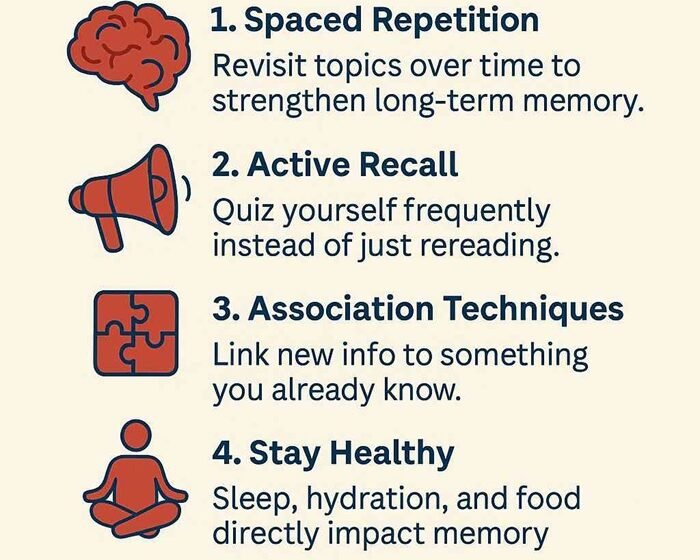
1. Active Recall: The Ultimate Study Method
Active recall is one of the most effective learning techniques. Instead of passively reviewing material, you force your brain to retrieve information.
How to use it:
- Close your book and write what you remember
- Use flashcards
- Take practice tests
- Teach someone else
This technique strengthens neural connections and improves long-term retention.
Why it works: Retrieval practice signals your brain that the information is important.
2. Spaced Repetition: Beat Forgetting
Spaced repetition involves reviewing information at increasing intervals (e.g., Day 1, Day 3, Day 7, Day 14).
Instead of cramming everything in one session, you revisit material just before you forget it.
Benefits:
- Improves long-term memory
- Reduces study time
- Prevents overload
This method aligns with how the brain naturally retains information.
3. The Memory Palace (Method of Loci)
This ancient technique involves associating information with familiar locations.
Steps:
- Choose a familiar place (your home)
- Assign information to specific spots
- Visualize walking through the space
For example, if memorizing planets, you might place each planet in a different room.
Why it works: The brain is excellent at remembering spatial environments.
4. Chunking: Break It Down
Chunking means dividing large information into smaller, manageable pieces.
Example:
Instead of remembering:194719521999
Break it into:1947 – 1952 – 1999
This technique reduces cognitive load and improves recall.
5. Mnemonics & Associations
Mnemonics use patterns, acronyms, or rhymes to remember information.
Examples:
- VIBGYOR (colors of the rainbow)
- “PEMDAS” for math operations
You can also create visual or emotional associations to make concepts memorable.
6. Dual Coding: Combine Visual + Verbal
Dual coding means using both words and visuals.
Techniques:
- Mind maps
- Diagrams
- Charts
- Infographics
Combining images with text strengthens memory pathways.
7. Interleaving: Mix Subjects
Instead of studying one topic for hours, mix different subjects or topics.
Example:
- Math → Science → English → Math
This improves problem-solving and adaptability.
8. The Feynman Technique
Named after physicist Richard Feynman, this method involves explaining concepts in simple terms.
Steps:
- Learn a concept
- Explain it like you’re teaching a child
- Identify gaps
- Simplify further
Teaching forces deep understanding.
9. Multi-Sensory Learning
Engage multiple senses:
- Read aloud
- Write notes
- Use visuals
- Listen to explanations
Using multiple senses strengthens memory formation.
10. Lifestyle-Based Memory Boosters
Memory isn’t just about study techniques—it’s also about lifestyle.
Key factors:
- Sleep (7–9 hours improves memory consolidation)
- Exercise (boosts brain function)
- Meditation (improves focus)
These habits significantly enhance cognitive performance.
Part 2: Productivity Hacks for Students
Memory alone isn’t enough—you also need productivity systems to stay consistent.
1. The Pomodoro Technique
Work in focused intervals:
- 25 minutes study
- 5 minutes break
After 4 sessions, take a longer break.
Benefits:
- Prevents burnout
- Improves focus
- Encourages consistency
2. The 2-Minute Rule
If you feel lazy, start with just 2 minutes.
Often, starting is the hardest part. Once you begin, momentum builds naturally.
“Starting is harder than continuing.” (common student experience)
3. Eliminate Distractions
Multitasking destroys productivity.
Tips:
- Keep phone away
- Use website blockers
- Study in a quiet place
Focused attention is essential for memory formation.
4. Use To-Do Lists
Plan your day with clear goals.
Example:
- Revise Chapter 1
- Practice 20 questions
- Review flashcards
This reduces decision fatigue and increases efficiency.
5. Prioritize Important Tasks (80/20 Rule)
Focus on tasks that give maximum results.
- Identify high-impact topics
- Study smart, not long
6. Study in Short, Deep Sessions
Long hours don’t guarantee results.
Instead:
- Study deeply for shorter periods
- Take breaks to recharge
7. Teach Others
Teaching reinforces your own learning.
- Study with friends
- Explain concepts aloud
- Join group discussions
This improves both memory and confidence.
8. Stay Consistent (Not Perfect)
Consistency beats intensity.
Studying 2 hours daily is more effective than 10 hours once a week.
9. Optimize Your Study Environment
Your environment affects productivity.
Ideal setup:
- Clean desk
- Good lighting
- Minimal noise
A distraction-free environment improves focus.
10. Track Your Progress
Measure improvement:
- Test yourself weekly
- Monitor weak areas
- Adjust strategies
This keeps you accountable and motivated.
Part 3: Combining Memory + Productivity
The real magic happens when you combine both.
Example Study System:
Morning:
- Review using active recall
Afternoon:
- Learn new topics using dual coding
Evening:
- Revise using spaced repetition
Weekly:
- Self-test and analyze mistakes
This integrated approach ensures maximum retention and efficiency.
Common Mistakes to Avoid
Many students unknowingly sabotage their learning.
Avoid:
- Rereading notes repeatedly
- Highlighting everything
- Cramming before exams
- Studying without testing yourself
These methods feel productive but don’t build strong memory.
Final Thoughts
Memory and productivity are not talents—they are skills.
With the right techniques, anyone can:
- Learn faster
- Remember longer
- Study efficiently
Start small. Pick 2–3 techniques like active recall, spaced repetition, and Pomodoro, and practice them consistently.
Over time, these habits will transform the way you learn.
Quick Summary
- Use active recall instead of rereading
- Apply spaced repetition to avoid forgetting
- Try memory techniques like chunking, mnemonics, and mind maps
- Use productivity hacks like Pomodoro and to-do lists
- Focus on consistency and lifestyle habits
Conclusion
Success in academics is not about intelligence—it’s about strategy.
By mastering memory techniques and productivity hacks, you gain a powerful advantage—not just in exams, but in lifelong learning.