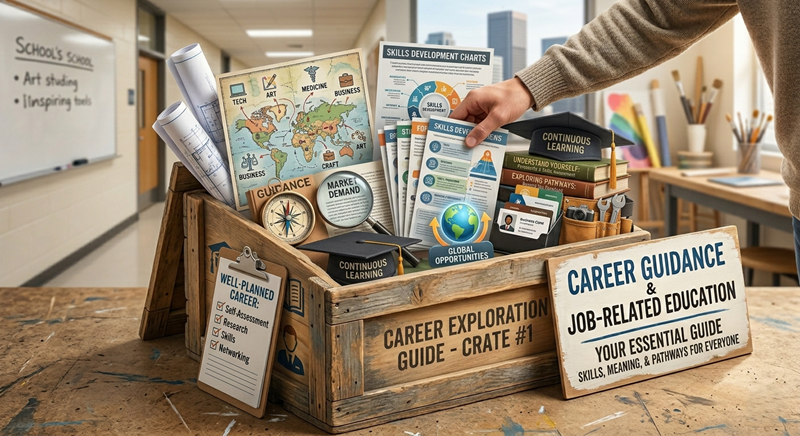

Career guidance and job-related education have become essential in today’s fast-changing world. Earlier, choosing a career was relatively simple because job roles were limited and stable. However, in the 21st century, rapid technological development, globalization, and evolving industries have made career decisions more complex. Students and job seekers now face hundreds of options, many of which did not exist a decade ago. Fields like artificial intelligence, data science, digital marketing, cybersecurity, and renewable energy have created entirely new career pathways.
Career guidance acts as a structured process that helps individuals understand their strengths, interests, and available opportunities so they can make informed decisions. Job-related education, on the other hand, focuses on skill development and practical learning required to succeed in specific careers. Together, they form the foundation of a successful professional life.
This article explores the importance of career guidance, emerging job trends, education pathways, skill development strategies, and how individuals can build a strong future in a competitive job market.
Understanding Career Guidance
Career guidance is the process of helping individuals choose, plan, and develop their careers. It involves self-assessment, exploration of career options, and strategic planning.
According to educational experts, career guidance helps students and professionals:
- Identify their strengths and weaknesses
- Understand their interests and personality traits
- Explore suitable career options
- Select the right academic courses
- Develop long-term career plans
In simple terms, career guidance is not just about choosing a job—it is about building a lifelong professional direction.
For example, a student interested in science may not only become a doctor or engineer but can also explore biotechnology, environmental science, or data analytics depending on their skills and interests.
Importance of Career Guidance in Today’s World
Career guidance is more important today than ever before due to several reasons:
1. Increasing Career Options
There are thousands of job roles available across industries. Without proper guidance, students often feel confused and overwhelmed.
2. Rapid Technological Changes
Automation and AI are replacing some traditional jobs while creating new ones. Career guidance helps individuals stay updated with these changes.
3. Mismatch Between Education and Employment
Many graduates struggle to find jobs because their education does not match industry needs. Guidance helps bridge this gap.
4. Better Decision Making
Proper guidance reduces the chances of wrong career choices, saving time, money, and effort.
5. Personal Satisfaction
Choosing the right career leads to better job satisfaction and mental well-being.
Job-Related Education: Bridging Theory and Practice
Job-related education focuses on practical knowledge and skills required in the workplace. Unlike traditional education, which emphasizes theory, job-oriented learning prepares individuals directly for employment.
Key Features of Job-Related Education:
- Skill-based learning
- Industry exposure
- Practical training
- Internships and apprenticeships
- Real-world problem solving
For example:
- A computer science student learns programming languages like Python and Java.
- A marketing student learns digital tools like SEO and social media advertising.
- A healthcare student trains in clinical environments.
This type of education ensures students are job-ready immediately after completing their studies.
Popular Career Fields in 2026
The job market in 2026 is driven by technology, sustainability, and global connectivity. Some of the most promising fields include:
1. Information Technology (IT)
Includes software development, cybersecurity, cloud computing, and AI engineering.
2. Data Science and Analytics
Organizations rely on data-driven decisions, making this one of the fastest-growing fields.
3. Healthcare and Medical Sciences
Doctors, nurses, pharmacists, and biomedical researchers are always in demand.
4. Digital Marketing
Businesses are shifting online, increasing demand for SEO experts, content creators, and social media managers.
5. Engineering Fields
Mechanical, civil, electrical, and new-age engineering like robotics and automation remain strong.
6. Government Jobs
Still a preferred option in many countries due to job stability and benefits.
7. Entrepreneurship
Starting businesses or startups has become a major career path supported by digital platforms.
How to Choose the Right Career Path
Choosing the right career requires a structured approach:
Step 1: Self-Assessment
Understand your interests, skills, personality, and values.
Step 2: Explore Career Options
Research industries, job roles, salaries, and growth opportunities.
Step 3: Evaluate Market Demand
Choose careers that have long-term demand and growth potential.
Step 4: Education Planning
Select appropriate courses, certifications, or degrees.
Step 5: Gain Practical Experience
Internships, workshops, and projects help build real-world skills.
Role of Skills in Career Success
Education alone is not enough in today’s job market. Skills play a crucial role in determining employability.
Important Skill Categories:
Technical Skills
- Coding and programming
- Data analysis
- Engineering design
- Digital tools
Soft Skills
- Communication
- Leadership
- Problem-solving
- Teamwork
Digital Skills
- Social media management
- Online marketing
- Content creation
Employers prefer candidates who combine technical knowledge with strong communication and adaptability skills.
Challenges Faced by Students and Job Seekers
Despite access to education, many individuals face challenges:
1. Lack of Awareness
Many students do not know about modern career options.
2. Peer and Family Pressure
Career choices are often influenced by others rather than personal interest.
3. Financial Constraints
Some courses and certifications are expensive.
4. Skill Gap
Education systems sometimes fail to match industry requirements.
5. Fear of Failure
Many individuals hesitate to take risks or explore new fields.
Solutions Through Career Guidance
Career guidance addresses these challenges by:
- Providing personalized counseling
- Conducting aptitude tests
- Offering mentorship programs
- Suggesting skill development courses
- Helping with career transition planning
Professional guidance ensures individuals make confident and informed decisions.
Future of Career Guidance and Education
The future of career guidance is becoming more technology-driven. Artificial intelligence, online counseling platforms, and virtual career assessments are transforming how people make decisions.
Key trends include:
- AI-based career prediction tools
- Online learning platforms (e-learning)
- Global job opportunities through remote work
- Continuous skill upgrading (lifelong learning)
In the future, career paths will be more flexible, and individuals will likely change jobs multiple times in their lifetime.
Conclusion
Career guidance and job-related education are essential pillars of modern professional life. They help individuals understand themselves, explore opportunities, and develop the skills required for success in a competitive world.
A well-planned career is not just about earning money—it is about building a meaningful and satisfying life. With proper guidance, continuous learning, and skill development, anyone can create a successful career path regardless of their background.
In a world full of opportunities and challenges, the right guidance acts as a compass that leads individuals toward clarity, confidence, and long-term success.