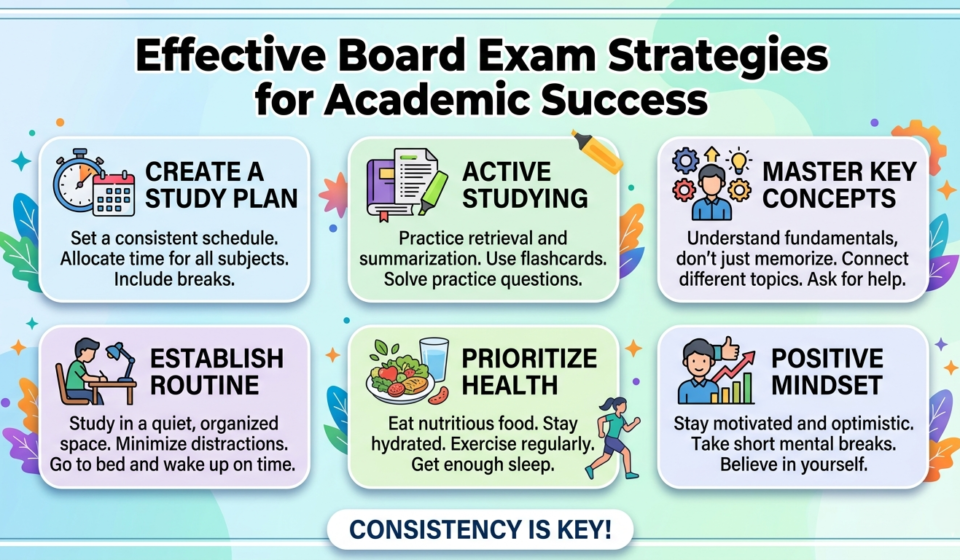

Board examinations are among the most important milestones in a student’s academic journey. Whether it is Class 10 or Class 12, these exams play a crucial role in shaping future educational and career opportunities. Many students experience stress, anxiety, and pressure during exam season, but with the right preparation strategies, success becomes achievable. Smart planning, disciplined study habits, and a positive mindset can significantly improve performance.
Education experts often emphasize the importance of structured learning, consistent revision, and time management for exam success. Modern educational resources also highlight the growing role of study planning and effective learning techniques in improving academic outcomes.
Understand the Exam Pattern and Syllabus
The first step toward effective board exam preparation is understanding the complete syllabus and exam pattern. Students should carefully review:
- Chapter weightage
- Important topics
- Marking scheme
- Previous year question trends
- Internal choices in papers
Knowing the syllabus helps students avoid wasting time on irrelevant topics. It also allows them to prioritize high-scoring chapters and plan their preparation more effectively.
Creating a checklist of all subjects and chapters can help track progress. Once students know what needs to be covered, preparation becomes more organized and less stressful.
Create a Realistic Study Timetable
A proper timetable is the backbone of successful exam preparation. Students should divide their available time wisely among all subjects. Difficult subjects may require more study hours, while easier subjects can be revised quickly.
An effective study schedule should include:
- Daily study goals
- Revision time
- Practice sessions
- Short breaks
- Sleep and relaxation time
Consistency is more important than studying for long hours occasionally. Studying 4–6 focused hours daily with concentration is often more productive than sitting with books all day without proper focus.
A balanced timetable prevents burnout and helps maintain motivation throughout the preparation period.
Focus on Conceptual Understanding
Memorizing answers without understanding concepts is one of the biggest mistakes students make during board exam preparation. Board exams increasingly focus on analytical and application-based questions.
Students should aim to:
- Understand core concepts clearly
- Learn formulas logically
- Practice numerical problems regularly
- Relate topics to real-life examples
Conceptual clarity improves confidence and enables students to solve unfamiliar questions effectively. Subjects like Mathematics and Science particularly require strong understanding rather than rote learning.
For example, understanding the relationship between variables in algebra becomes easier through visualization:
y=mx+b
m
b-10-8-6-4-2246810-10-5510y-interceptx-intercept
Similarly, geometry concepts become more intuitive when formulas are clearly understood:
a2+b2=c2
a
b
c=a2+b2≈21.21
a2+b2=c2≈225.00+225.00=450.00abc
Practice Previous Year Question Papers
Solving previous year question papers is one of the most effective strategies for board exam preparation. It helps students:
- Understand question patterns
- Improve time management
- Identify weak areas
- Build confidence
- Reduce exam anxiety
Students should attempt papers in a timed environment similar to actual exam conditions. This practice improves writing speed and accuracy.
Sample papers and mock tests also help students evaluate their preparation level. After solving a paper, students should carefully analyze mistakes and revise weak topics accordingly.
Make Smart Notes for Revision
Short notes are extremely useful during the final days before exams. Instead of revising entire textbooks repeatedly, students can revise concise notes quickly.
Good revision notes should include:
- Important formulas
- Definitions
- Key concepts
- Diagrams
- Dates and facts
- Important reactions or equations
Color coding and flowcharts can make notes more engaging and easier to remember. Visual learning techniques improve memory retention and help students revise faster.
Use Active Learning Techniques
Passive reading often leads to poor retention. Active learning methods help students remember concepts for a longer period.
Some effective active learning techniques include:
Self-Testing
After completing a chapter, students should test themselves without looking at the book.
Teaching Others
Explaining concepts to friends or family members strengthens understanding.
Mind Mapping
Mind maps help organize information visually and improve recall.
Flashcards
Flashcards are useful for formulas, vocabulary, and quick facts.
These techniques make learning interactive and improve concentration during study sessions.
Time Management During Exams
Preparing well is important, but managing time during the actual exam is equally crucial. Many students lose marks not because they lack knowledge, but because they fail to complete the paper properly.
Effective exam-time strategies include:
- Read the question paper carefully
- Start with easy questions
- Avoid spending too much time on one question
- Keep time for revision at the end
- Write neat and structured answers
Students should allocate time according to marks. Long-answer questions deserve more detailed explanations, while short questions should be answered concisely.
Practicing timed mock tests beforehand helps students improve speed and accuracy.
Maintain Proper Health and Sleep
Many students sacrifice sleep during exams, believing it increases study time. However, lack of sleep negatively affects concentration, memory, and performance.
Healthy habits during exam preparation include:
- Sleeping 7–8 hours daily
- Drinking enough water
- Eating nutritious food
- Avoiding excessive junk food
- Taking short physical breaks
Regular exercise and meditation can also reduce stress and improve mental focus. A healthy body supports a healthy mind, which is essential for effective learning.
Avoid Last-Minute Cramming
Last-minute cramming creates confusion and increases anxiety. Instead of trying to learn new topics at the final moment, students should focus on revising already prepared material.
The final days before exams should be dedicated to:
- Quick revisions
- Formula practice
- Solving sample papers
- Reviewing important concepts
Students should avoid comparing their preparation with others. Every student learns differently, and unnecessary comparison can reduce confidence.
Stay Positive and Motivated
Mental attitude plays a huge role in academic success. Fear and negative thinking often reduce performance, even among well-prepared students.
Students should:
- Believe in their preparation
- Avoid unnecessary stress
- Focus on improvement instead of perfection
- Stay motivated through small achievements
Parents and teachers also play an important role in encouraging students emotionally during exam season.
Positive affirmations and realistic expectations help students stay calm and confident.
Reduce Distractions
Social media, gaming, and excessive smartphone use can significantly reduce study efficiency. Students should create a distraction-free study environment.
Helpful strategies include:
- Keeping phones away while studying
- Using productivity apps if necessary
- Studying in a quiet environment
- Following fixed study hours
Focused study sessions are far more productive than distracted long hours.
Subject-Wise Preparation Tips
Mathematics
- Practice daily
- Learn formulas thoroughly
- Focus on stepwise solutions
- Solve multiple sample problems
Science
- Understand concepts deeply
- Practice diagrams and numericals
- Revise formulas and reactions regularly
Social Science
- Use timelines and maps
- Learn important keywords
- Write point-wise answers
English and Languages
- Improve writing practice
- Focus on grammar
- Read chapters carefully
- Practice literature-based questions
Each subject requires a slightly different preparation strategy, and students should adapt accordingly.
Importance of Revision
Revision is the key to long-term retention. Without revision, students may forget previously studied topics.
A strong revision plan should include:
- Weekly revision sessions
- Monthly chapter reviews
- Final full-syllabus revisions
Repeated revision strengthens memory and boosts confidence before exams.
Conclusion
Board exams are important, but they should not become a source of overwhelming pressure. Success in board examinations depends more on smart preparation than on studying endlessly. Proper planning, conceptual clarity, regular practice, healthy habits, and a positive mindset together create the foundation for excellent performance.
Every student has the ability to perform well with discipline and consistency. Instead of fearing exams, students should treat them as an opportunity to showcase their learning and hard work. With the right strategies and balanced preparation, achieving high scores in board exams becomes much more attainable.