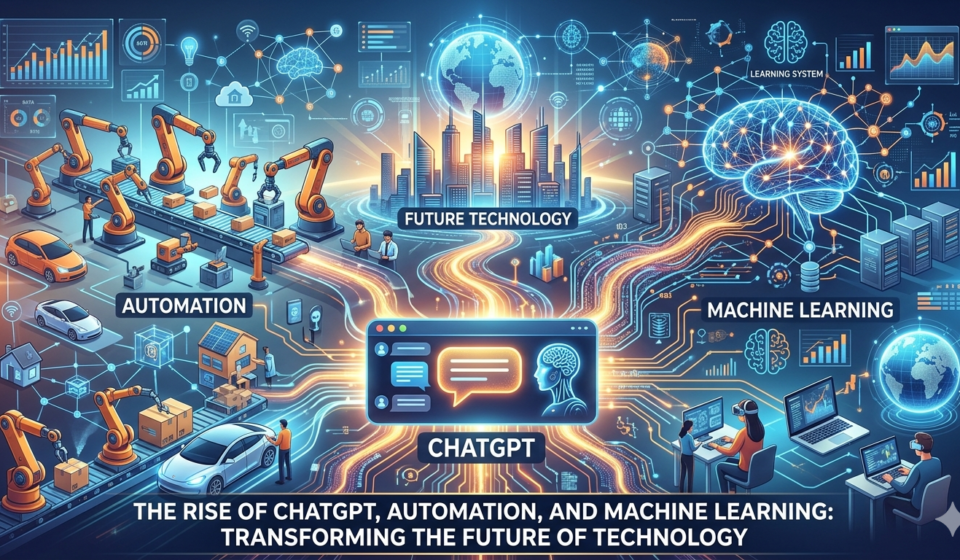
The Rise of ChatGPT, Automation, and Machine Learning: Transforming the Future of Technology

The world is experiencing a technological revolution driven by artificial intelligence (AI), automation, and machine learning. Among these advancements, tools like ChatGPT have captured global attention for their ability to mimic human conversation, generate content, and automate complex tasks. These innovations are not only reshaping industries but also redefining how humans interact with machines.
In this article, we explore the evolution, applications, benefits, and challenges of ChatGPT, automation, and machine learning, and how they are shaping the future.
Understanding ChatGPT
ChatGPT is a powerful AI-based chatbot developed by OpenAI. It uses advanced natural language processing (NLP) to understand and generate human-like text responses. Unlike traditional chatbots that rely on pre-programmed scripts, ChatGPT is built on large language models trained on vast datasets, enabling it to respond intelligently to a wide range of queries.
At its core, ChatGPT works by predicting the next word in a sequence based on patterns learned from data. This allows it to generate coherent and contextually relevant responses in real time.
Over time, ChatGPT has evolved into a versatile tool capable of:
- Writing articles and blogs
- Answering complex questions
- Generating code
- Translating languages
- Assisting in research and education
Its ability to handle text, images, and even audio inputs makes it a cornerstone of modern AI applications.
What is Machine Learning?
Machine learning (ML) is a subset of artificial intelligence that enables computers to learn from data without being explicitly programmed. Instead of following fixed instructions, ML systems identify patterns and improve their performance over time.
There are three main types of machine learning:
1. Supervised Learning
Involves training a model on labeled data. For example, predicting house prices based on historical data.
2. Unsupervised Learning
Deals with unlabeled data, where the model identifies patterns or groupings on its own.
3. Reinforcement Learning
Involves learning through trial and error, where the system receives rewards or penalties based on actions.
ChatGPT itself is built using a combination of supervised learning and reinforcement learning, making it capable of generating highly refined responses.
The Role of Automation in Modern Technology
Automation refers to the use of technology to perform tasks with minimal human intervention. From manufacturing robots to software bots, automation has become a key driver of efficiency and productivity.
Types of Automation
- Industrial Automation: Robotics in factories
- Business Process Automation (BPA): Automating workflows
- Robotic Process Automation (RPA): Software bots handling repetitive tasks
- AI-Powered Automation: Intelligent systems like ChatGPT
Automation is now being combined with AI and machine learning to create “smart automation,” where systems can adapt and improve over time.
How ChatGPT, ML, and Automation Work Together
The integration of ChatGPT, machine learning, and automation creates a powerful ecosystem. Here’s how they complement each other:
- Machine Learning provides the intelligence
- ChatGPT acts as the interface for communication
- Automation executes tasks efficiently
For example, in customer service:
- ChatGPT handles user queries
- ML models analyze user behavior
- Automation systems resolve tickets or trigger workflows
This synergy leads to faster, more efficient operations across industries.
Applications Across Industries
1. Customer Service
AI chatbots powered by ChatGPT are revolutionizing customer support. They provide 24/7 assistance, reduce wait times, and improve user satisfaction.
2. Healthcare
Machine learning models help in diagnosing diseases, while AI assistants assist doctors with patient data and research.
3. Education
Students can use ChatGPT as a virtual tutor, while educators automate grading and administrative tasks.
4. Content Creation
From blog writing to social media posts, AI tools can generate high-quality content quickly and efficiently.
5. Software Development
Developers use ChatGPT to write, debug, and optimize code, significantly speeding up development cycles.
6. Finance
Automation and ML are used for fraud detection, risk analysis, and algorithmic trading.
These applications highlight how AI technologies are transforming traditional workflows and creating new opportunities.
Benefits of ChatGPT and Automation
1. Increased Efficiency
Tasks that once took hours can now be completed in seconds.
2. Cost Reduction
Businesses can reduce operational costs by automating repetitive tasks.
3. Scalability
AI systems can handle thousands of tasks simultaneously without fatigue.
4. Improved Accuracy
Machine learning models reduce human errors in data analysis and decision-making.
5. Enhanced User Experience
ChatGPT provides personalized and interactive experiences for users.
Challenges and Limitations
Despite their advantages, these technologies come with challenges:
1. Lack of True Understanding
ChatGPT generates responses based on patterns, not actual comprehension.
2. Bias in Data
AI systems may reflect biases present in training data.
3. Job Displacement
Automation can replace certain jobs, raising concerns about employment.
4. Security Risks
AI systems can be misused for generating misinformation or cyberattacks.
5. Dependence on Data
Machine learning models require large amounts of data to function effectively.
Addressing these challenges is crucial for the responsible development of AI technologies.
Ethical Considerations
As AI becomes more integrated into society, ethical concerns are gaining importance:
- Data Privacy: Protecting user information
- Transparency: Understanding how AI makes decisions
- Accountability: Determining responsibility for AI actions
- Fairness: Eliminating bias and discrimination
Organizations and governments are working on frameworks to ensure ethical AI development.
The Future of AI, Automation, and ChatGPT
The future of these technologies is incredibly promising. Advancements in AI are leading to the development of “agentic AI,” where systems can plan, reason, and execute tasks autonomously.
Emerging Trends
- AI Agents: Autonomous systems performing complex workflows
- Hyperautomation: Combining AI, ML, and RPA for end-to-end automation
- Multimodal AI: Systems that understand text, images, and audio
- Personal AI Assistants: Highly customized AI companions
In the coming years, we can expect AI to become more integrated into daily life, from smart homes to advanced business operations.
Impact on the Workforce
The rise of AI and automation is transforming the job market:
Jobs at Risk
- Data entry
- Customer support (basic roles)
- Repetitive manual tasks
Jobs in Demand
- AI and ML engineers
- Data scientists
- Automation specialists
- AI ethics consultants
Rather than replacing humans entirely, AI is likely to augment human capabilities, creating new roles and opportunities.
How Businesses Can Adapt
To stay competitive in the AI-driven era, businesses should:
- Invest in AI and automation tools
- Train employees in new technologies
- Focus on data-driven decision-making
- Implement ethical AI practices
- Continuously innovate and adapt
Organizations that embrace these changes will have a significant advantage in the digital economy.
Conclusion
ChatGPT, automation, and machine learning are at the forefront of the technological revolution. Together, they are transforming industries, improving efficiency, and redefining human-machine interaction.
While challenges such as bias, job displacement, and ethical concerns remain, the potential benefits far outweigh the risks when these technologies are used responsibly.
As we move forward, the key lies in balancing innovation with ethics, ensuring that AI serves humanity in a meaningful and beneficial way.
The future is not just automated—it is intelligent, adaptive, and deeply interconnected.