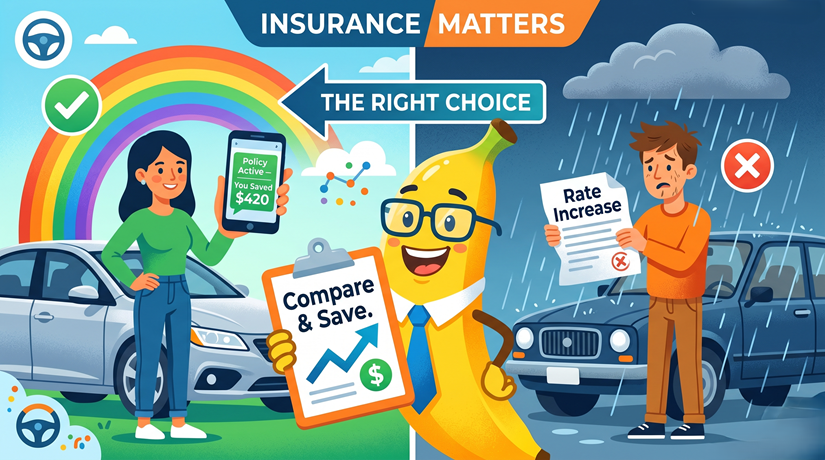

Let’s be honest: buying auto insurance ranks somewhere between going to the dentist and folding fitted sheets. It’s confusing, expensive, and full of jargon like “subrogation” and “UIM endorsement.” Yet, every state except New Hampshire requires it. And even in New Hampshire, you’d be foolish to drive without it.
But here’s the good news: auto insurance doesn’t have to be a black hole for your money. In fact, the average driver overpays by nearly $400 per year simply because they don’t understand how the system works. This guide will teach you exactly how to save hundreds of dollars while actually improving your coverage.
By the time you finish reading, you’ll know:
- What each type of coverage really does (and what you can skip)
- How insurers calculate your rate – and how to hack it
- When to raise your deductible (and when to keep it low)
- Why usage-based insurance might be your ticket to huge savings
Let’s pop the hood and take a look inside.
Chapter 1: The 5 Layers of Auto Insurance – Explained Like You’re 20
Most people just buy whatever the agent recommends. That’s like taking the first price a car salesman gives you. Instead, understand these five core coverages. They form every auto insurance policy in America.
1. Liability Coverage (Bodily Injury & Property Damage)
What it does: Pays for injuries and damages you cause to other people and their property. It does not pay for your car or your medical bills.
State minimums: Usually something like 25/50/25 ($25k per person injury, $50k total per accident, $25k property damage).
The trap: Minimums are dangerously low. A single ER visit plus a week in the hospital can exceed $50k easily. If you cause a multi-car accident, you could be personally sued for the difference.
Smart move: Buy at least 100/300/100. It costs only 15–20% more than state minimums but gives 4x the protection.
2. Collision Coverage
What it does: Pays to repair or replace your car after an accident, regardless of fault. Covers hitting another car, a tree, a pole, or rolling into a ditch.
Deductible: Usually $250, $500, or $1,000. You pay the deductible; insurance pays the rest.
When to drop it: Once your car’s market value drops below about $3,000, self-insure. Put the premium money into a savings account.
3. Comprehensive Coverage (Often called “Comp”)
What it does: Covers non-collision damage – theft, fire, vandalism, hail, flood, falling tree branches, hitting a deer.
Surprising fact: Comprehensive claims are often cheaper than collision claims. That’s why comp deductibles can be lower.
Pro tip: If you live in a hail-prone area (Texas, Oklahoma, Nebraska), keep comprehensive even on an older car. One hailstorm can total a vehicle.
4. Medical Payments (MedPay) or Personal Injury Protection (PIP)
What it does: Pays your medical bills (and passengers’) regardless of fault. PIP is broader – it can cover lost wages, childcare, even funeral costs.
No-fault states: In Florida, New York, Michigan, and a dozen others, PIP is mandatory.
The catch: Your health insurance might already cover car accident injuries. But PIP often has no deductible and covers co-pays.
5. Uninsured/Underinsured Motorist (UM/UIM)
What it does: Protects you if a driver with no insurance (or too little insurance) hits you.
Shocking stat: About 13% of drivers nationwide have zero insurance. In Mississippi, Florida, and New Mexico, it’s over 25%.
Why you need it: If an uninsured drunk driver totals your Lexus and breaks your leg, your only recourse without UM is to sue someone who has no money. UM steps in and pays as if they had coverage.
Best value: UM/UIM is usually very cheap – often $50–100 per year for $100k of coverage.
Chapter 2: The Secret Math Behind Your Auto Insurance Rate
Insurers don’t pull numbers from a hat. They use complex algorithms based on risk factors. Here’s how each factor affects your premium – and what you can do about it.
| Factor | Impact on Rate | How to Improve It |
|---|---|---|
| Driving record | Huge – a single at-fault accident can raise rates 40% for 3 years | Take a defensive driving course (often lowers rate 5–10%). Avoid small claims. |
| Credit score | Massive – in most states, poor credit doubles your rate | Pay bills on time. Check credit report for errors. Some states (CA, MA, MI) ban credit scoring. |
| Age | High under 25, over 70 | Young drivers: good student discount (up to 25%). Seniors: complete a mature driver course. |
| Vehicle | Sports cars and luxury SUVs cost more | Before buying, get insurance quotes. A Honda Civic costs half to insure vs. a Dodge Charger. |
| Location | Urban areas pay 30–50% more than rural | If moving, compare zip codes. Parking in a garage vs. street can lower rates. |
| Annual mileage | Each 5,000 miles adds ~8% | If you work from home, report lower mileage honestly. Consider pay-per-mile insurance. |
| Marital status | Married drivers pay ~15% less | Statistically, married people file fewer claims. Nothing you can do except… well, get married. |
The biggest hidden factor: Continuity of coverage. If you let your policy lapse for even one day, insurers treat you like a brand-new, high-risk driver. Rates can double. Always renew before expiration.
Chapter 3: 7 Proven Strategies to Lower Your Auto Insurance Bill (Without Dropping Needed Coverage)
Strategy 1: Raise Your Deductible – But Do It Intelligently
Moving from a $500 deductible to $1,000 saves about 15–20% on collision and comprehensive. That’s often $150–300 per year. Can you afford an extra $500 out-of-pocket if you crash? If yes, raise it. Put the savings into an emergency fund.
Strategy 2: Bundle Home and Auto (or Renters and Auto)
The “multi-policy discount” is usually 10–25%. If you rent, a renters policy costs as little as $15/month – and bundling might save you $30/month on auto. That’s net $15 savings plus free renters insurance.
Strategy 3: Switch to Usage-Based Insurance (UBI)
Programs like Progressive Snapshot, Allstate Drivewise, or State Farm Drive Safe & Safe track your driving via an app or plug-in device. Good drivers (smooth braking, limited late-night driving, low mileage) save 20–40%.
Warning: If you drive aggressively, UBI will raise your rate. Try a “telematics trial” during a calm month.
Strategy 4: Ask for Every Discount (Yes, Even the Weird Ones)
Insurers don’t volunteer discounts. You must ask. Common ones:
- Good student (B average or higher, up to age 25)
- Distant student (if your child is away at college without a car)
- Military or federal employee
- Affinity group (alumni association, Costco membership, AARP)
- Paid-in-full discount (pay 6 months upfront instead of monthly)
- Paperless/autopay discount (usually $20–50 per year)
Strategy 5: Drive an Older Car – Or the Right New Car
A 2026 Tesla Model Y has high repair costs and expensive parts. A 2026 Subaru Outback has low insurance group ratings. Before buying any car, ask for an insurance group rating (1-50, where 50 is most expensive). Also check IIHS safety ratings – cars with automatic emergency braking often qualify for discounts.
Strategy 6: Improve Your Credit Score (If You Live in a Credit-Allowed State)
In most states, a 100-point credit score increase can lower your rate 15–25%. Pay down credit card balances, dispute errors, and avoid new credit inquiries before shopping for insurance.
Strategy 7: Shop Around Every 12 Months – Religiously
Loyalty is punished, not rewarded. New customer discounts are always better than renewal rates. Every year, get quotes from:
- Direct writers (Geico, Progressive, State Farm, Allstate)
- Independent agents (they shop multiple carriers like Travelers, Safeco, Nationwide)
- Regional carriers (Erie, Auto-Owners, Amica – often have the best rates and service)
Pro tip: Compare the total annual cost – not just the monthly payment. Many insurers add installment fees.
Chapter 4: Special Cases – High-Risk Drivers, SR-22, and Classic Cars
If You Have a DUI or Multiple Tickets
You’ll be placed in the “non-standard” market. Carriers like The General, Bristol West, and Dairyland specialize in high-risk drivers. Rates will be painful – often $3,000–6,000/year – but after 3 clean years, you can return to standard carriers.
SR-22 Insurance
This isn’t a policy; it’s a form your insurer files with the state proving you have coverage. Required after serious violations. The filing fee is $25–50, but the underlying insurance will be expensive. Don’t let it lapse – the state will suspend your license immediately.
Classic or Collector Cars
If you have a vintage Mustang or a Porsche 911 that you drive fewer than 3,000 miles per year, standard auto insurance is a terrible fit. Get a stated value policy from Hagerty, Grundy, or Heacock. They cost half as much and cover the car’s true value, not depreciated actual cash value.
Chapter 5: When to File a Claim – And When to Pay Out of Pocket
Here’s the single most important financial rule in auto insurance:
Never file a claim for damage under $1,500.
Why? Because a single at-fault claim can increase your premium by $500–800 per year for three years. That’s $1,500–2,400 in total increased cost. Plus, you lose any “accident-free discount” (typically 15–20%).
Examples:
- Scratched bumper: pay $800 out of pocket.
- Cracked windshield: check if your state requires free glass replacement (Florida, Kentucky, South Carolina do). Otherwise, pay $300 yourself.
- Hit a deer: comprehensive claim is usually fine – most insurers don’t surcharge for “acts of nature.”
- Minor fender bender: exchange cash with the other driver if possible. Get a written release.
The claim threshold rule: If the repair cost is less than 2x your deductible, pay it yourself. If it’s more, file a claim.
Conclusion: Drive Confidently, Save Intelligently
Auto insurance is never going to be fun. But it doesn’t have to be a confusing money pit. By understanding the five core coverages, hacking your risk factors, using strategies like raising deductibles and bundling, and shopping annually, you can easily save $300–700 per year.
Your one action item today: Pull out your current auto insurance policy (or log into your app). Look at your liability limits. If they’re at state minimums, call your agent and raise them to 100/300/100. It will cost less than a dinner out – and it could save your entire financial future.
Then, set a calendar reminder for 11 months from now: “Compare auto insurance rates.” Future you will thank you.
Final keyword check (natural integration): auto insurance, car insurance coverage, cheap auto insurance, compare car insurance rates, liability coverage explained, comprehensive vs collision, usage-based insurance, telematics discount, high-risk driver insurance, uninsured motorist protection, auto insurance deductible, pay-per-mile insurance, SR-22 insurance, bundling home and auto.