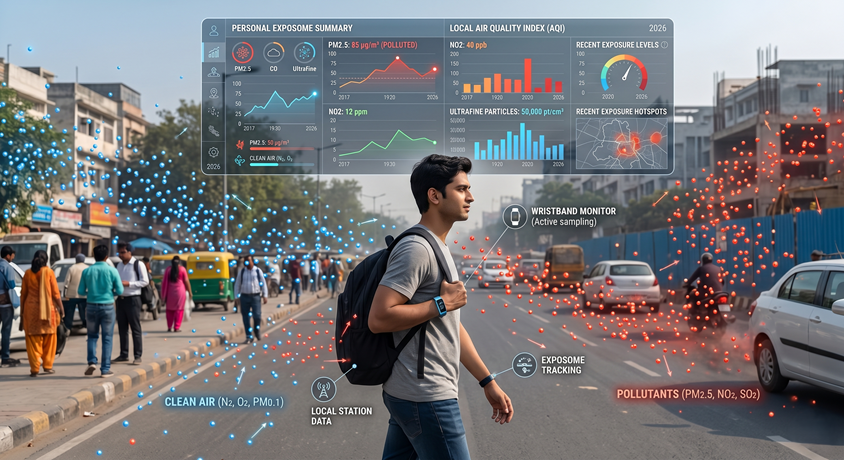

For decades, we believed our DNA was our destiny. However, in 2026, the scientific community has undergone a paradigm shift toward Exposome Science. While the Human Genome Project mapped our internal blueprint, the “Human Exposome” maps everything else: the totality of environmental exposures we encounter from conception to death. Emerging research suggests that while genetics account for roughly 10–20% of disease risk, the exposome—the air we breathe, the chemicals we touch, and the noise we endure—governs the remaining 80%.
The Three Spheres of Exposure
Exposome science categorizes our environment into three overlapping layers that interact with our biology:
- The External Exposome: Large-scale factors including air quality, climate change, urban design (green spaces vs. concrete), and noise pollution.
- The Specific External Exposome: Targeted chemical encounters such as pesticides in food, “forever chemicals” (PFAS) in tap water, and occupational hazards.
- The Internal Exposome: How the body responds to external stress. This is measured through biomonitoring—analyzing blood, hair, and breath for biomarkers of inflammation, oxidative stress, and metabolic shifts.
2026 Breakthrough: The “Expotype”
In 2026, clinicians have moved beyond general advice to the “Expotype”—a personalized, time-resolved map of an individual’s unique exposure vector.
| Environmental Factor | Health Impact | 2026 Monitoring Tool |
| PM2.5 / Wildfire Smoke | Respiratory inflammation & cognitive decline. | Wearable air-quality sensors synced to smartphones. |
| Noise Pollution | Chronic cortisol elevation & cardiovascular strain. | Smartwatch decibel tracking with “stress-gap” alerts. |
| Microplastics/PFAS | Endocrine disruption & metabolic interference. | High-resolution mass spectrometry (Home-kit testing). |
| Light Pollution | Circadian rhythm disruption & sleep disorders. | Ambient light sensors with automated “blue-light” home dimming. |
The Cumulative “Soup” Effect
The most significant finding of recent 2026 studies, including an atlas published in Nature Medicine, is that single exposures rarely cause disease in isolation. Instead, it is the cumulative soup of exposures that triggers illness. For instance, while a specific nutrient deficiency or a low level of a pollutant might have a negligible impact on its own, the combination of 20 such factors can explain up to 43% of the variation in critical health markers like triglycerides.
Built Environment and “Precision Prevention”
Urban planning in 2026 is being redesigned through the lens of the exposome. The concept of Built Environment Wellness focuses on:
- Green-Space Access: Strategically placing parks to mitigate “urban heat islands” and reduce respiratory stress.
- Acoustic Architecture: Designing residential zones with sound-dampening materials to combat the newly recognized health risks of chronic noise.
- Walkability: Reducing dependence on combustion-engine vehicles to lower localized air pollution.
The 2026 Outlook: The “Global Exposome Summit” held in April 2026 has officially called for a “Mission Exposome”—a global data space connecting environmental, health, and social data. This will allow AI to predict, in real-time, how a person’s current environment is impacting their hour-to-hour health.
Are you interested in a guide on how to minimize your “Specific External” exposure through water filtration and diet, or should we look at the latest wearables for personal air-quality monitoring?