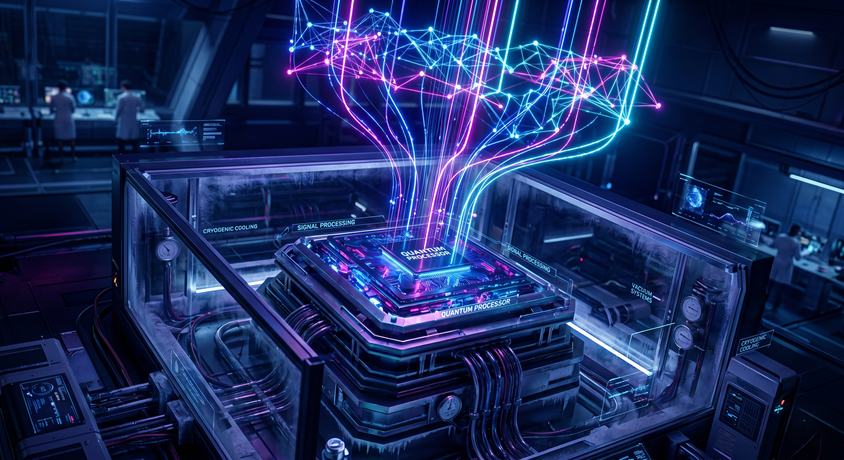

In 2026, the synergy between quantum physics and artificial intelligence has moved beyond the laboratory. Quantum Machine Learning (QML)—the integration of quantum algorithms into AI frameworks—is addressing the “computational wall” faced by classical supercomputers. By leveraging the principles of superposition and entanglement, QML can process multidimensional data structures at speeds that make current GPUs look like calculators.
The “Quantum Advantage” in Predictive AI
The primary breakthrough of 2026 is the realization of “Quantum Advantage” in specific high-dimensional tasks. While classical AI navigates complex data one “corridor” at a time, QML explores the entire “maze” simultaneously.
- Quantum Neural Networks (QNNs): Unlike classical neurons, quantum neurons can exist in multiple states at once. This allows QNNs to identify non-linear patterns in massive datasets—such as genomic sequences or global climate models—that are invisible to classical architectures.
- Exponential Feature Mapping: QML can map data into an “exponentially large” Hilbert space. This allows for the separation of data points that remain inseparable in the lower-dimensional transformations used by conventional deep learning.
The Hybrid Era: NISQ Devices in 2026
We are currently in the era of Noisy Intermediate-Scale Quantum (NISQ) technology. Because pure quantum systems are still sensitive to environmental “noise,” the industry has embraced Hybrid Classical-Quantum Models:
| Component | Responsibility | Performance Impact |
| Quantum Processor (QPU) | Handles heavy optimization and complex feature extraction. | Reduces optimization time from months to days. |
| Classical Processor (GPU/TPU) | Manages data preprocessing, final inference, and deployment. | Ensures model stability and real-world scalability. |
2026 Industry Breakthroughs
Two sectors are currently leading the adoption of QML due to the immense complexity of their data variables:
- Drug Discovery: Traditional molecular simulation is notoriously slow. QML frameworks in 2026 are reducing drug discovery timelines by 50–70%. By simulating molecular interactions at the subatomic level, researchers can predict the efficacy of a compound before a single lab test is conducted.
- Financial Modeling: Quantum algorithms are now used for real-time fraud detection and “Monte Carlo” simulations for risk assessment. In 2026, hybrid models are managing multi-variable logistics and portfolio optimization for global hedge funds, reacting to market volatility in microseconds.
The QML Ecosystem: Cloud Democratization
You no longer need to own a cryogenically cooled quantum computer to utilize this power. In 2026, platforms like IBM Quantum, Google Willow, and AWS Braket have democratized access. Developers can now “rent” quantum circuits via the cloud, integrating QML layers into their existing Python and Next.js applications using open-source libraries like Qiskit and PennyLane.
The 2026 Outlook: IBM’s roadmap has surpassed the 4,000-qubit mark, and Google’s “Willow” chip has demonstrated the ability to perform complex error correction exponentially. This means the transition from “experimental QML” to “standardized QML” is officially complete.
Are you interested in a technical deep dive into Quantum Support Vector Machines, or would you like to see how to integrate a quantum-inspired optimization layer into a standard TensorFlow workflow?