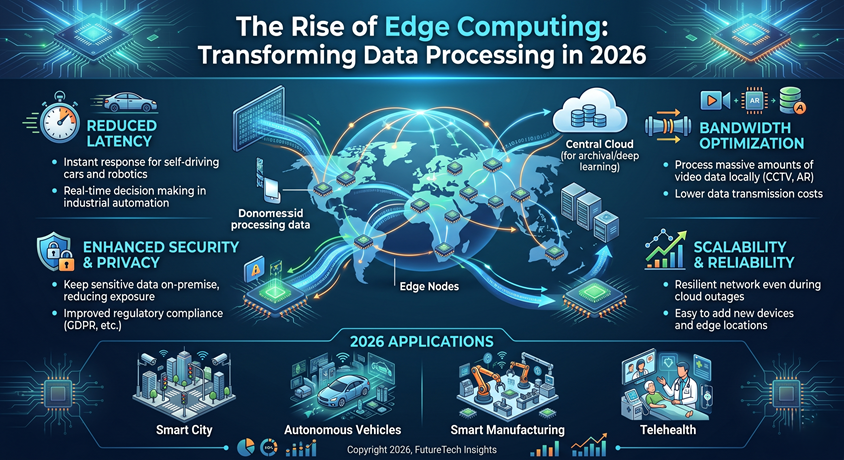

In 2026, as billions of IoT devices generate zettabytes of data, sending every piece of information to a centralized cloud is no longer feasible. Edge computing—processing data closer to its source—has emerged as the critical architecture for real-time applications. From autonomous delivery drones to smart hospital wards, the “Edge” is where the most vital decisions of the modern world are made.
The Shift from Centralized to Distributed
While the cloud remains the king of long-term storage and heavy-duty model training, it is no longer the primary responder. The latency inherent in traditional cloud models—often ranging from 50ms to 150ms—is unacceptable for 2026’s mission-critical tasks. Edge computing slashes this to under 10ms, enabling:
- Autonomous Navigation: Vehicles reacting to road hazards in real-time without waiting for a server signal.
- Predictive Maintenance: Factory sensors detecting a microscopic gear misalignment and halting the line instantly.
- Healthcare Monitoring: Wearables that process cardiac data locally to alert emergency services the second an anomaly occurs.
5G and AI: The Power Duo at the Edge
The explosion of Edge Computing in 2026 is fueled by two converging technologies: 5G Advanced and Edge AI.
- 5G Connectivity: Provides the high-bandwidth, low-latency “pipe” that allows thousands of devices per square kilometer to communicate seamlessly.
- Edge AI (Small Language Models): We have moved past the need for massive data centers to run intelligence. Compact, highly efficient “Micro LLMs” now run directly on device hardware, allowing for sophisticated natural language processing and image recognition without an internet connection.
Security and Data Privacy
In an era of heightened regulation and cyber threats, the Edge offers a significant advantage: Data Sovereignty. By processing sensitive information—such as facial recognition or medical records—on-site, companies minimize the “attack surface.” If the data never leaves the local network, it cannot be intercepted in transit to the cloud.
The Verdict for 2026
The debate is no longer “Cloud vs. Edge.” Instead, the industry has embraced a Hybrid Architecture. The cloud acts as the “brain” for long-term memory and strategy, while the edge serves as the “nervous system,” providing the lightning-fast reflexes required for a world that never sleeps.
Actionable Takeaway: Organizations looking to scale in 2026 should audit their data pipelines to identify “latency-sensitive” workloads. Shifting these to the edge can reduce bandwidth costs by up to 35% while dramatically improving user experience.
Are you interested in seeing the full 1500-word breakdown on specific manufacturing use cases, or should we focus on the security protocols for these decentralized networks?